
Choosing the fixture shape (e.g. spider wash)
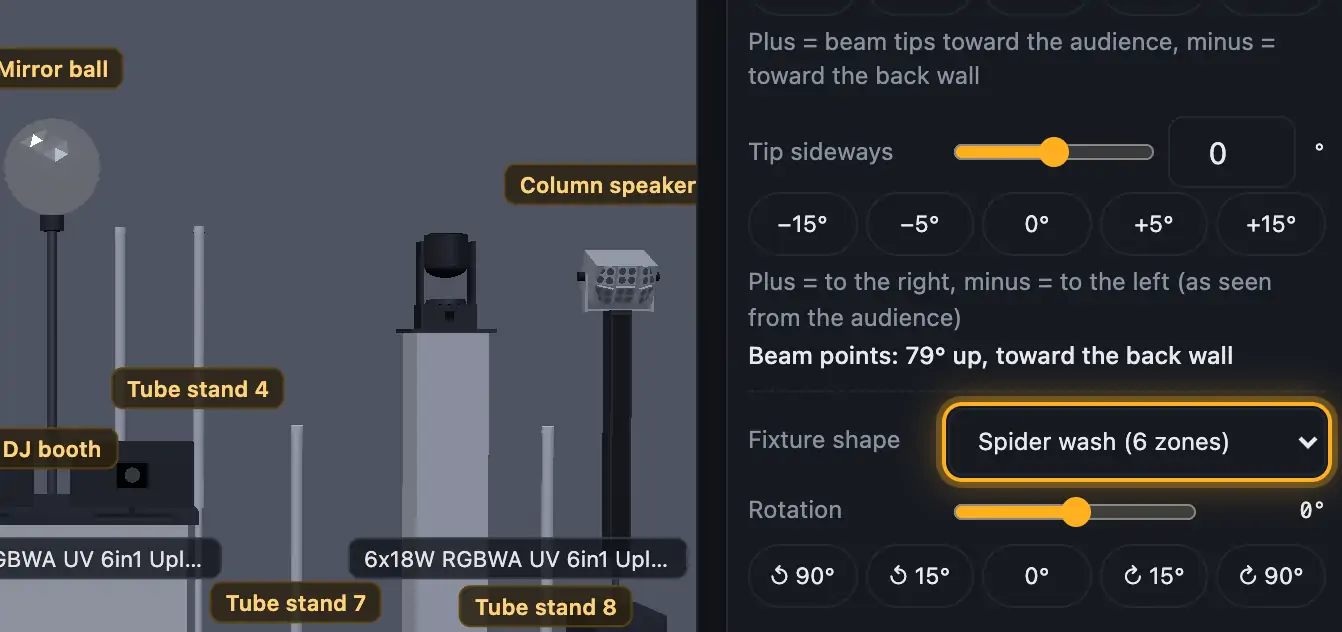
The fixture shape decides how a fixture looks in the 3D view. This helps when a fixture is patched in SoundSwitch with a simple profile, e.g. a spider wash as a 6-channel uplight.
Step by step
- Open “Gear” on the left. Edit mode turns on.
- Click the fixture.
- Under “Fixture shape”, choose:
- “automatic”: the visualizer recognizes a spider by “Spider” in the fixture name, otherwise it shows a bar or par.
- “Standard (bar/par)”: a normal housing.
- “Spider wash (6 zones)”: a white housing in a yoke with six angled zones whose beams fan out.
- a specific model under “Combo fixture”, e.g. “Chauvet DJ GigBAR 2”: the real bar with pars, derbys, laser and strobe. More under Combo fixtures.
- The 3D view shows the new model right away.
More from “Fixture profiles & rig”
- How Droplit recognizes your lightsDroplit reads your SoundSwitch project and builds your rig from it: which fixtures there are, what they can do, which groups they belong to and in which order they stand. You don't have to create anything by hand.Summary
- Roles: what a fixture does in showsThe role decides what a fixture does in your shows. The designer assigns it when it recognizes your rig, and if it got something wrong, you change it with a few clicks.Summary
- Roles & order: check groups and rolesIn the “Roles & order” window you check and change what the designer recognized from your patch: groups, order, roles, moving heads, positions and gobo mapping.Summary
- Taking over your rig in another projectA checked rig doesn't only apply to copies with exactly the same patch. If you open a project where your fixtures are patched a little differently, the designer takes over groups, roles and order from the most similar rig you have already checked.Summary
- Hiding fixtures you don't bringNot every fixture in your patch comes to every gig. If you hide it, it disappears from the 3D view and the floor plan, and in “Fixtures & stage” the shows leave it out too.Summary