
Roles: what a fixture does in shows
The role decides what a fixture does in your shows. The designer assigns it when it recognizes your rig, and if it got something wrong, you change it with a few clicks.
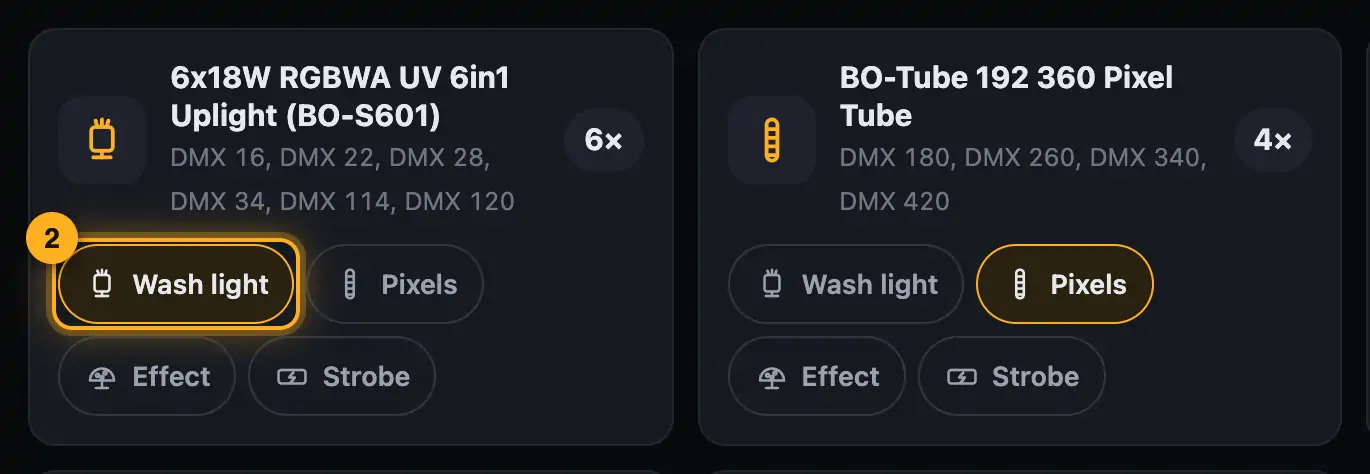
Step by step
- Open “Getting started” and go to the step “These are your lights”. Every fixture model has a card.
- Tap the right role for a fixture: “Wash light”, “Pixels”, “Moving head”, “Effect” or “Strobe”.
- If a fixture does several things (e.g. an effect bar with pars, derbys and laser), it says “This fixture does several things – each part gets its own role:”. Choose a role for each part.
- Continue through the assistant with “Next”. The roles are saved.
- Alternatively, change the role of a whole group under “Roles & order” (see Roles & order).
More from “Fixture profiles & rig”
- How Droplit recognizes your lightsDroplit reads your SoundSwitch project and builds your rig from it: which fixtures there are, what they can do, which groups they belong to and in which order they stand. You don't have to create anything by hand.Summary
- Roles & order: check groups and rolesIn the “Roles & order” window you check and change what the designer recognized from your patch: groups, order, roles, moving heads, positions and gobo mapping.Summary
- Taking over your rig in another projectA checked rig doesn't only apply to copies with exactly the same patch. If you open a project where your fixtures are patched a little differently, the designer takes over groups, roles and order from the most similar rig you have already checked.Summary
- Hiding fixtures you don't bringNot every fixture in your patch comes to every gig. If you hide it, it disappears from the 3D view and the floor plan, and in “Fixtures & stage” the shows leave it out too.Summary
- Sparks and hazeFor safety reasons, Droplit never controls spark machines, fog machines and hazers, flames, CO2, confetti or bubble machines. You keep triggering them yourself in SoundSwitch.Summary