Song analysis: beatgrid, drops and breaks
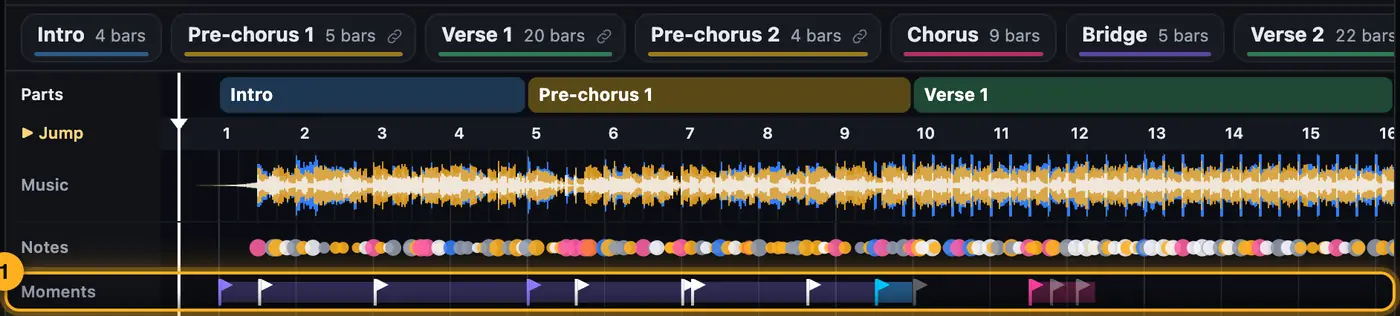
To make the show fit the music, Droplit takes the beatgrid from SoundSwitch and listens to the audio file hit by hit. From that it builds the song parts Calm, Groove, Build-up, Drop and Breakdown, and the special moments: hard hits, drum passages, breaks, fills and impacts.
Step by step
- Tempo and first beat come from SoundSwitch. So Droplit counts the same bars as SoundSwitch. If music is already playing before the first beat (e.g. a guitar intro), it counts the bars before it too, so the intro gets light as well.
- It finds every single hit, how strong it is and what kind it is (kick, snare, tom, cymbal, whole band).
- It puts the start of the bar where the bass usually kicks in and the chords change.
- It compares the bars with each other: what repeats (e.g. every chorus) belongs to the same part and later gets the same look. Borders sit on whole 4-bar phrases.
- It sorts the parts by energy:
- the parts with the most energy become “Drop” (in rock and pop usually the chorus),
- parts that are clearly quieter become “Calm”,
- the rest becomes “Groove”,
- the last bars before a louder part become “Build-up”, as long as the build in the music,
- a calm part right after a drop becomes “Breakdown”.
- On top of that it looks for the special moments (see Special moments).
More from “Song shows”
- What is a song show?A song show is a light show for exactly one song. It follows the song's structure with calm parts, build-ups and drops, and plays along in SoundSwitch automatically as soon as you load the song.Summary
- Song studio – parts, zones, notes and effect chainsThe song page works like a lighting console: tools on the left, the stage in the middle, below it the song as part cards and as a timeline with the beatgrid. On the right you adjust whatever you tapped below – the whole song, a part, a zone or a single note.Summary
- Your song is missing from the listThe song list only shows songs that SoundSwitch has already created a script file for. SoundSwitch creates this file once you open the song there, place an effect and save.Summary
- Choosing and opening a song“Songs” lists every song that SoundSwitch has set up for a show. Tap a song to open it in the Studio.Summary
- Special moments: hits, breaks and impacts in the lightThe mood builds the look for every song part. On top of that, Droplit now listens to every single hit and plays up the spots a lighting designer would program by hand: hard hits of the whole band, drum passages, breaks, fills, the impact after a build and the ending.Summary