Missing gobo images: finding a fixture profile
To show real gobo images in the preview and offer “Gobo, rotation & prism” in the Studio, Droplit needs a fixture profile for your moving heads. If it’s missing, you find it through the status light.
Step by step
- Tap the status light at the top right, then “Find profile” on the point “Gobos are still missing in the 3D preview”.

Tap „Find profile“ on this item. - The window “Find a fixture profile” opens. If profiles are missing for several fixtures, choose the right one under “Fixture”.
- Tap “Search the fixture database”. “Fixtures & stage” opens with the fixture database for this fixture. Many fixtures already have ready-made profiles there.
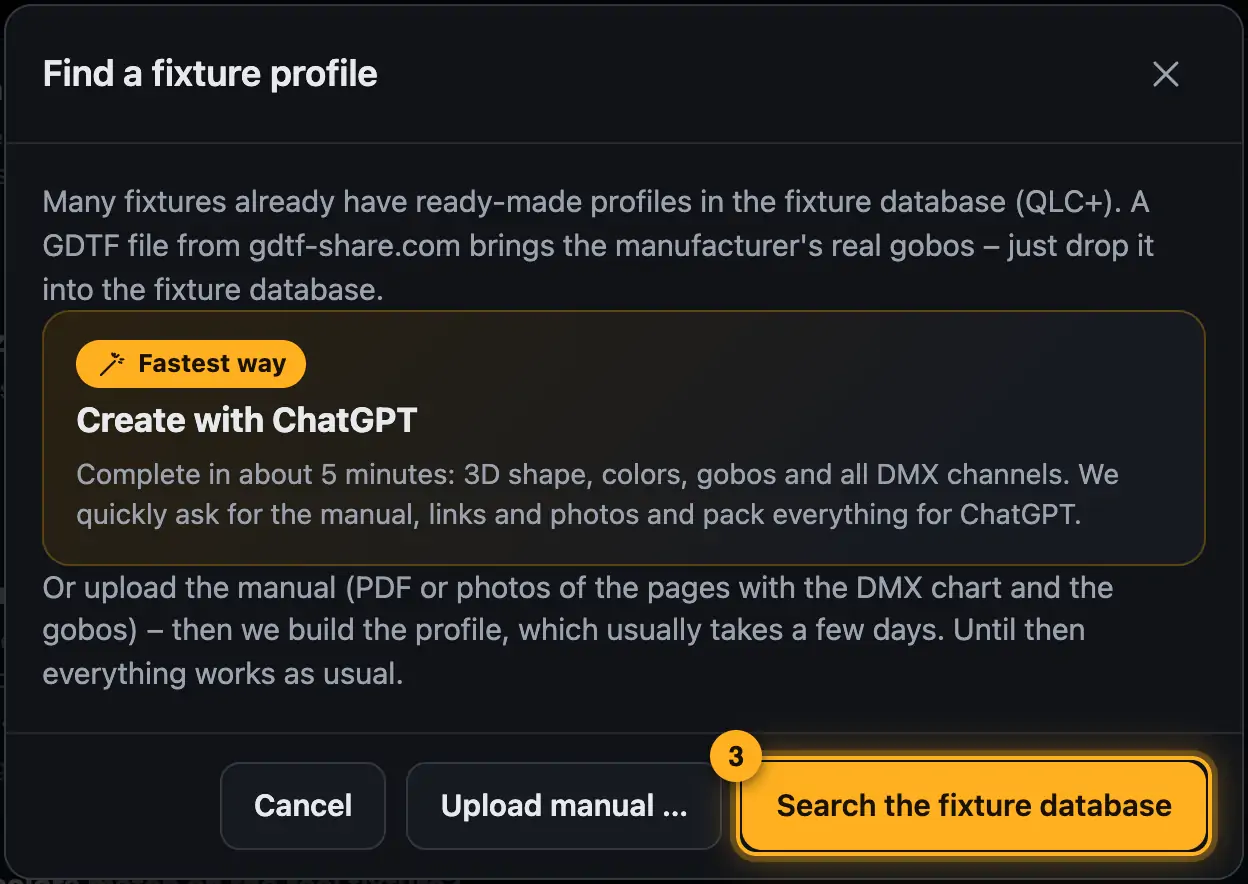
Database first, then the manual. - If nothing turns up, open the window again and tap “Upload manual …”. Choose a PDF or photos of the pages with the DMX table and the gobos. You can pick several files at once.
- You see “Thanks! Your manual has arrived. We’ll let you know when the profile is ready.”
More from “Projects & banks”
- The Overview: banks and padsAfter you open a project, you land in the Overview. It shows the banks of your SoundSwitch project as pads, much like on a controller, and you pick the slot you want to design.Summary
- Banks and slotsSoundSwitch organizes Autoloops and Static Looks in banks of 32 slots each. Droplit shows the same banks and names as SoundSwitch and writes to exactly the slot you choose.Summary
- Filling an empty slot with a new showA pad with “+” is a free slot. When you tap it, Droplit immediately builds a first show for your lights. You adjust it in the Studio and then save it to SoundSwitch.Summary
- Opening and editing an existing showTo open a show that’s already in SoundSwitch, tap its pad. Droplit loads it exactly as it’s saved in SoundSwitch and plays it in the preview.Summary
- Renaming, deleting or moving a showDroplit builds and changes shows in their slot. You can rename a show in the Studio. Deleting and moving aren’t part of Droplit; you do that in SoundSwitch.Summary